
Grief is something we all experience, but that doesn’t mean we all experience it in the same way.
When someone we love dies, we can sometimes expect grief to follow a particular path. We may think there will be a period of intense sadness, followed by gradually feeling better, until eventually we are somehow “over it”.
But grief doesn’t really work like that.
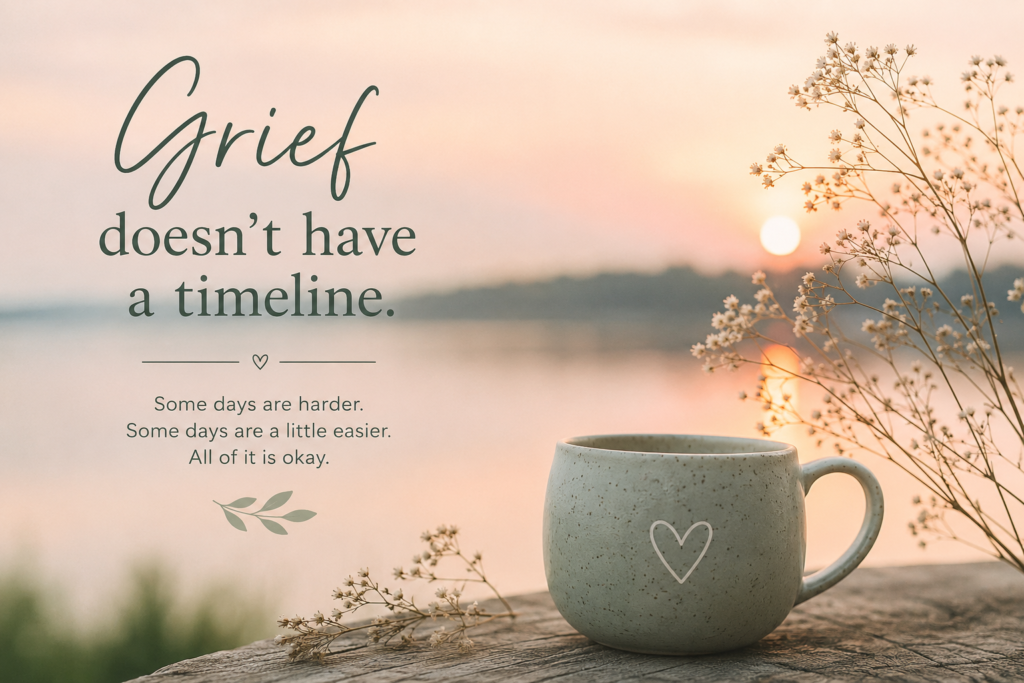
There is no set timeline.
There is no right way to grieve.
And there is no point where you are supposed to simply stop missing someone.
Grief can change over time
In the early days, weeks and months following a loss, grief can feel all-consuming.
You may experience sadness, anger, shock, confusion or numbness. You may find yourself thinking about the person constantly, or struggling to believe that they are no longer here.
Then, sometimes, things begin to feel a little easier.
You might laugh at something.
You might enjoy a day out.
You might find yourself thinking about something other than your loss.
And then, seemingly out of nowhere, a smell, a song, a photograph, a familiar place or a particular date can bring those feelings rushing back.
This doesn’t mean you have gone backwards.
It doesn’t mean you are failing to cope.
It simply means you are grieving.
There isn’t a right way to feel
One of the difficult things about grief is that it can look completely different from one person to another.
You may cry every day.
You may hardly cry at all.
You may want to talk about the person you have lost constantly, while someone else in your family doesn’t want to talk about them.
You may feel angry.
You may feel relieved.
You may feel guilty for feeling relieved.
You may feel completely numb.
You may experience several of these feelings in the same day.
All of these experiences can be part of grief.
There isn’t a checklist of emotions that you need to work through, and there isn’t a particular order that they need to happen in.
Grief can be complicated
Sometimes we can feel like we don’t have permission to grieve.
Perhaps the relationship was complicated.
Perhaps the person who died was someone you had a difficult relationship with.
Perhaps the loss happened a long time ago, but something has brought those feelings back to the surface.
Perhaps you are grieving something other than a death – a relationship, a part of your identity, a future you imagined, or a significant change in your life.
Loss can take many forms.
And sometimes the feelings surrounding that loss can be difficult to make sense of.
You don’t have to justify your grief for it to be real.
You can carry someone with you
There can be a lot of pressure to “move on” after someone dies.
But perhaps moving forward doesn’t mean leaving someone behind.
The person you have lost can remain an important part of your story.
Their memory, the things they taught you, the experiences you shared and the love you had for them can continue to exist alongside your life now.
Moving forward doesn’t mean forgetting.
It doesn’t mean that you have stopped caring.
And it certainly doesn’t mean that you have stopped grieving.
Sometimes, it is about finding a way to carry your loss while continuing to live your life.
You don’t have to do it alone
Grief can feel incredibly lonely, even when you are surrounded by people.
Sometimes the people around us don’t know what to say.
Sometimes we don’t want to burden the people we love.
Sometimes we simply need somewhere to talk where we don’t have to worry about making someone else uncomfortable with our feelings.
Counselling can provide that space.
At Gems Counselling Space, I offer a safe, supportive and non-judgemental environment where you can explore your grief at a pace that feels comfortable for you.
There is no expectation that you need to have everything worked out.
You don’t need to know what you want to say.
You don’t need to feel a certain way.
You can simply bring yourself and whatever you are experiencing at that moment.
It’s okay if you are still grieving
If you have been wondering whether you “should” be feeling better by now, perhaps the most important thing to remember is this:
There is no deadline for grief.
Some days may feel easier.
Some days may feel incredibly hard.
And sometimes you may experience both within the same day.
Be gentle with yourself.
Your grief is personal to you, and there is no timeline that you have to follow.
If you feel that having someone alongside you would help, I’m here to listen.
At Gems Counselling Space, I work with people experiencing bereavement, loss and end-of-life concerns, offering a space where you can feel heard, understood and supported.
You don’t have to walk through it alone.
Gemma
Gems Counselling Space